Discover the journey of Nicolas and Helena Roerich, and their commitment to peace and the protection of cultural heritage.
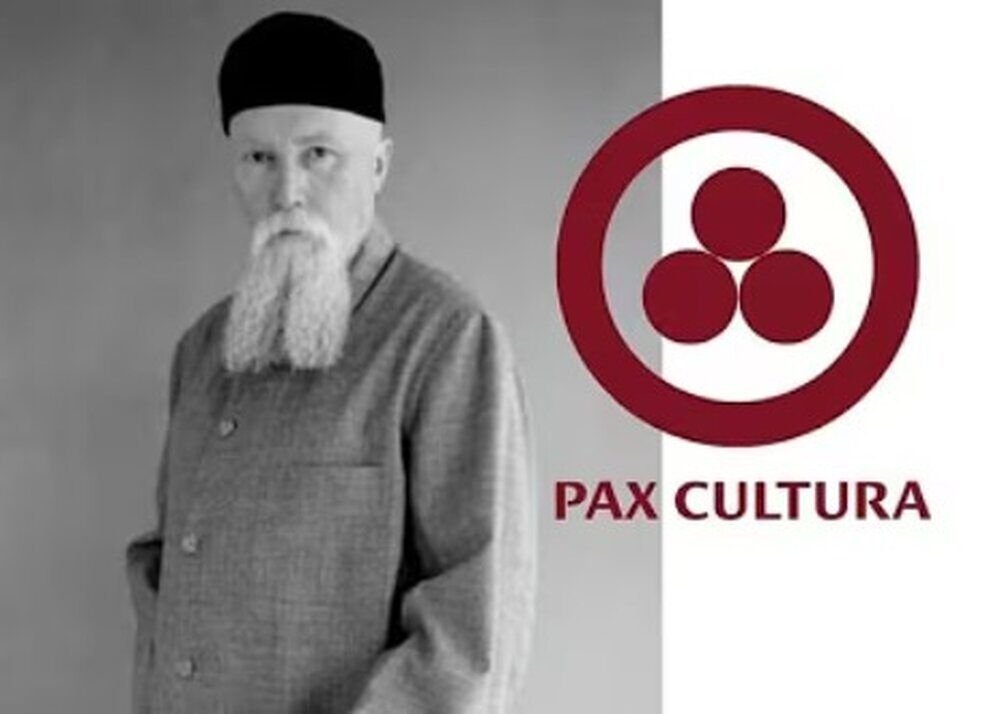
He is known today above all as a great humanist, and as a Russian painter, writer and archaeologist. A prolific painter, he produced some seven thousand canvases infused with his travels — Russia, Northern Europe, the United States and India — with his quest for spirituality, and with his love of nature, peace and culture. Beyond his artistic career, Nicolas Roerich was the architect of the treaty for the protection of artistic and scientific institutions and of historic monuments, known as the "Roerich Pact," which marks the culmination of his commitment to the protection of cultural heritage.
During his stays in Europe and the United States, Nicolas Roerich was in contact with traditional organizations and had privileged relations with leading figures of the Theosophical Society. He left the United States in April 1923 for India, where he organized a scientific and artistic expedition into Central Asia — in which his son George, an eminent polyglot orientalist, took part — the purpose of which was to gather information on the cultures and religions of the region.
During his travels, Nicolas Roerich turned his gaze toward the Himalayan regions, Central Asia, Mongolia and the Gobi, where Tradition places great sages. In his books Heart of Asia and Shambhala, he recounts the exchanges he had with learned lamas concerning this "land of the gods." One of them is said to have told him: "If you wish to understand Asia and to approach it as a welcome visitor, greet your host with the most sacred word: Shambhala."
Daughter of Ekaterina and Ivan Shaposhnikov, and later the wife of Nicolas Roerich, Helena was a woman of letters. From an early age she showed a genuine passion for reading; she took an interest in nature, in the life of different peoples, and in the East. A niece of the composer Mussorgsky, she herself became an accomplished pianist.
On 28 October 1901, Helena married the artist, explorer and peace advocate Nicolas Roerich. In 1920 she accompanied him to New York for the first exhibition of his paintings in America. That same year, she began writing a series of books called Agni Yoga, or the Teaching of Living Ethics, which address the evolution of humanity by drawing on both the ancient knowledge of the East and the experimental approach of Western science. She also wrote At the Crossroads of the East and The Foundations of Buddhism, and was the Russian translator of Helena Blavatsky's The Secret Doctrine.
After her death in 1955 in Kalimpong, east of Darjeeling in India, her students published two books drawn from the letters she had sent them across the world. She was one of the founders of the Agni Yoga Society, which today is the custodian of her written works.
"Culture belongs to no man, group, nation or era. It is the shared property of all humanity and the heritage of generations. Without Culture, there is neither truth, nor unity, nor peace." — Nicolas Roerich
